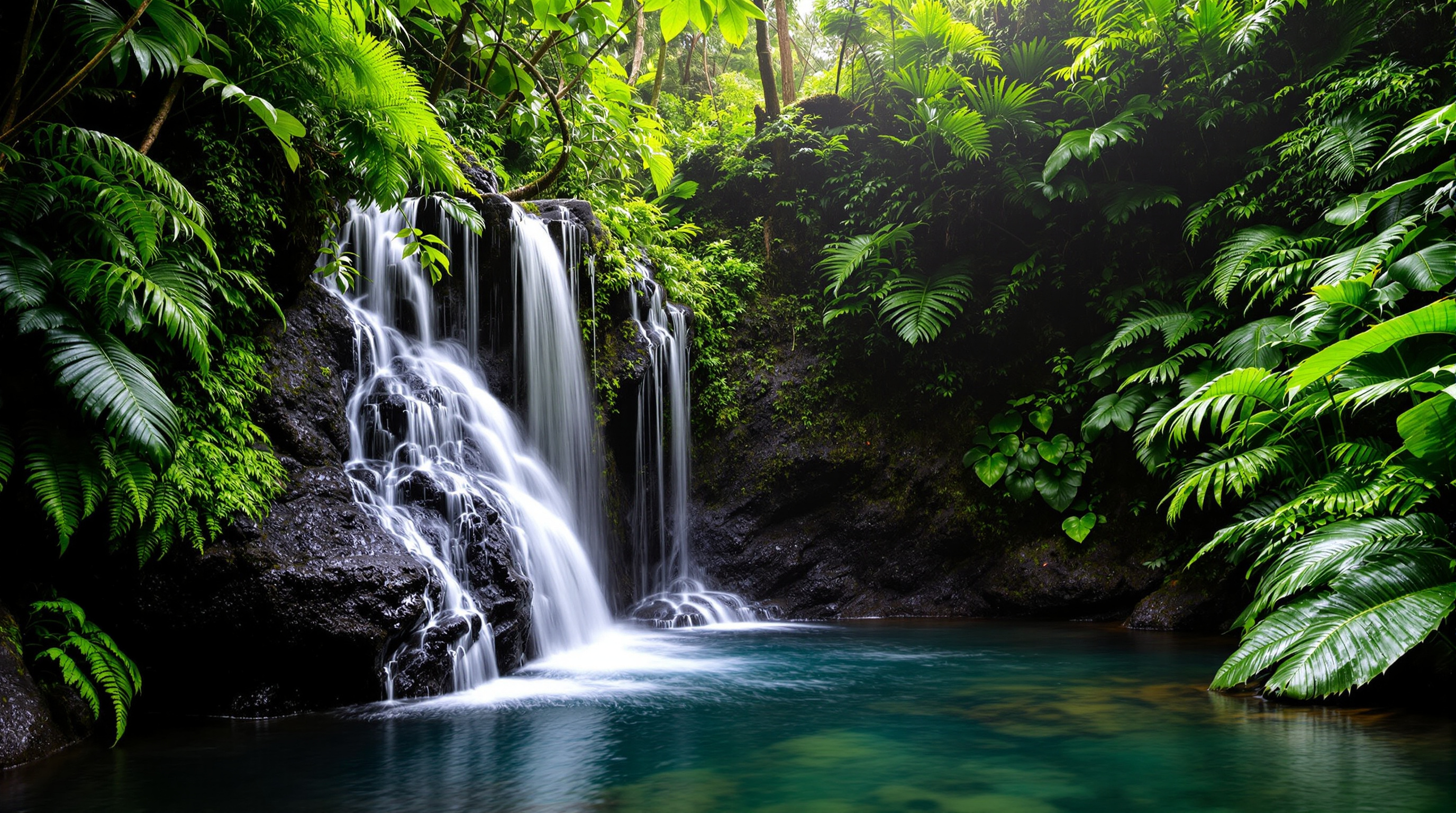
The studio's location list included a single entry simply called "Waterfall" - a private-land cascade on the north shore available only by advance reservation, at considerable cost, for sessions that wanted the full Hawaii fantasy: a family on mossy rock with white water curtaining behind them. The private arrangement is long gone, but waterfall portraiture on Kauai is very much alive, and the studio's lessons on shooting falling water still apply - along with the public alternatives that deliver it.
Why Waterfalls Are Worth the Trouble
A waterfall background does three things a beach cannot. It fills the frame with motion you can render two ways - silk at slow shutter speeds, glass beads at fast ones. It surrounds subjects in green: ferns, kukui and monstera crowd Kauai's stream gullies and make a lush, enclosed world. And it solves harsh light, because waterfall gullies live in open shade most of the day. The trade-offs are equally real: slippery rock, spray on the lens, mosquitoes, and on Kauai the ever-present risk of flash flooding in stream country.
The Public Alternatives
Wailua Falls - the famous double cascade near Lihue, photographed from the roadside overlook. No legal trail to the base; shoot from the rail with a long lens in morning light, when rainbows form in the mist. Opaekaa Falls - a tall ribbon visible from a maintained overlook in Wailua River State Park, with parking and restrooms; the easiest waterfall view on the island, detailed by the state parks division. Hoopii Falls - reachable by a muddy unofficial trail through Kapaa woodland; lovely swimming-hole cascades, but respect posted access and never enter after rain. For portraits with people at the water, the modest cascades and pools along public stream trails photograph better than the giant falls, which work best as backdrops seen from overlooks.
The state parks division's Wailua River listing includes the Wailua and ʻŌpaekaʻa Falls vistas. Its fee note, effective February 2026, lists $5 entry for non-residents and $10 parking per non-resident vehicle, with daily hours of 7:00am to 7:45pm. These are state park fees, not fees for the beach park at the river mouth.
Access needs a separate check. Under the division's 8 October 2026 notice describing the 21 September partial reopening, individual kayakers could not access Fern Grotto, and hiking beyond the trailhead and access to Secret Falls remained closed. The 7 October 2026 rainfall summary also recorded river rises closing highway sections near Hanalei and Wainiha. A scenic vista, a river landing and a waterfall trail are different destinations; confirm permission for the particular one before leaving.
Light and Timing
Overcast days are waterfall days - the gully shade goes soft and even, and the green saturates. In sun, shoot early or late when the cliff walls block direct light. For silky water, you want 1/4 to one full second of exposure, a tripod and a polarizer to cut leaf glare; for portraits, keep the shutter at 1/200s or faster and let the water freeze - children will not hold still for long exposures, and neither will waterfalls' breeze.
Safety, Legality and Respect
Kauai's streams rise with terrifying speed when it rains in the mountains - check the forecast and never ignore rising water or sudden debris. Many waterfall approaches cross private or state land where access is restricted; trespassing closes locations for everyone, so honor every sign. Stream rocks wear an invisible algae glaze - footwear with real tread is mandatory, and the National Weather Service's flood warnings at weather.gov/hfo are the last word on whether stream country is open for business today.
Composition Ideas
- Subjects on dry rock at the pool's edge, fall behind, shot long to compress and enlarge the water.
- Slow-shutter scenic of the full cascade as an album establishing frame.
- Detail frames: ferns, wet stone, a lei on mossy rock.
Season by Season
Waterfall photography on Kauai runs opposite to beach logic: the wet season is the show season. November through March, the falls run full and the gullies go saturated green - but the same rains that feed the cascades close the trails, so the working pattern is to shoot the first dry day after rain, when flow remains high and footing has begun to recover. Summer brings lower, clearer flows: less thunder, better swimming-hole clarity, and safer rock work for portraits at the public cascades. The roadside giants behave accordingly - Wailua Falls is at its broadest in winter and sometimes splits into multiple ribbons, while Opaekaa's overlook works year-round in any flow. Whatever the season, the flash-flood rule has no exceptions: if rain is falling in the mountains above your gully, the session is over, regardless of how blue the sky looks at the coast.
Pair a morning waterfall session with an afternoon beach session from the location library - the two-environment day was the studio's favorite full-album formula, and the scenic field guide covers the landscape side of the craft.