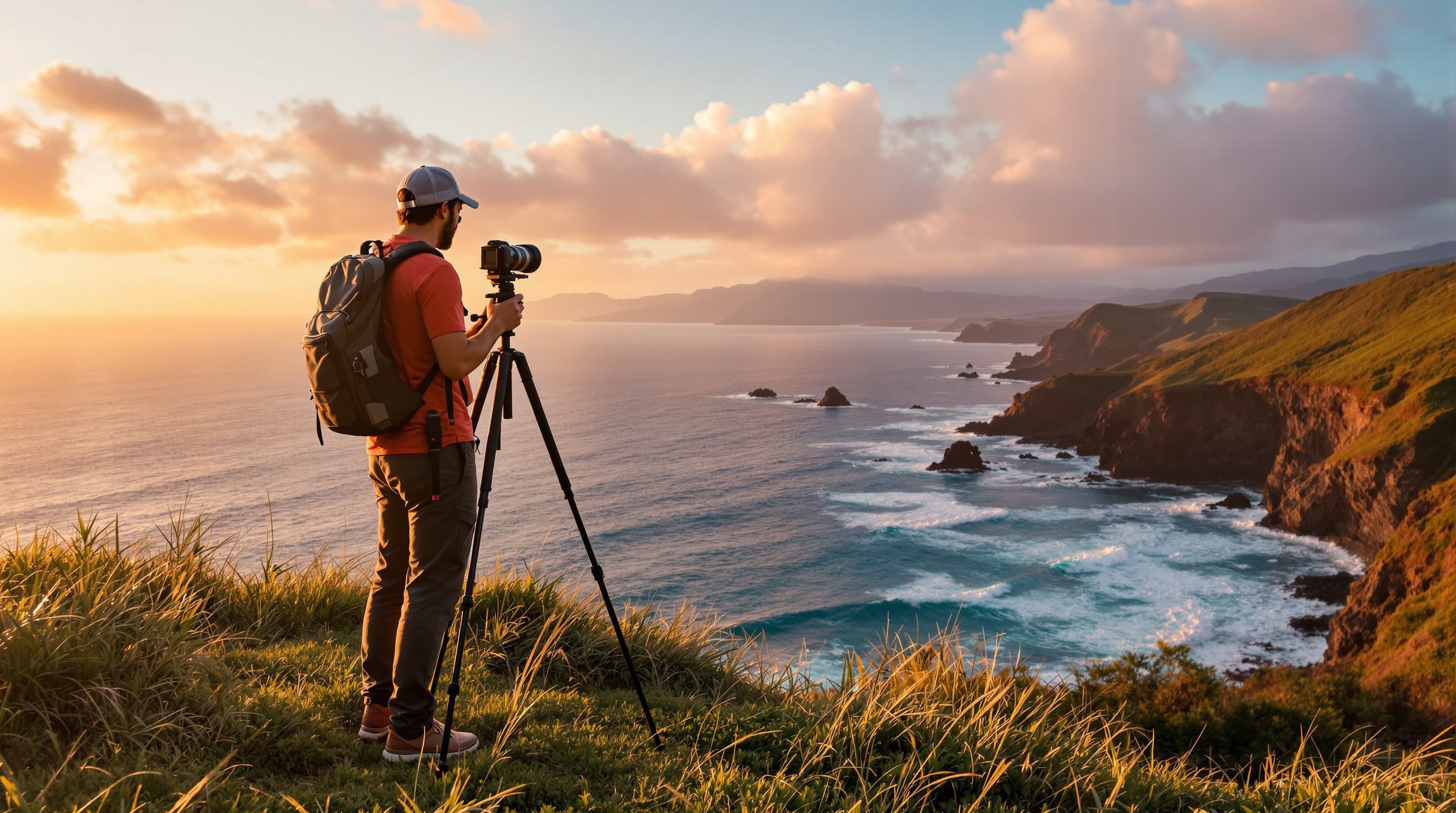
For years this studio offered private workshops for visitors who wanted to improve their photography while taking advantage of Kauai's scenery - instruction tailored to each student's level and whatever equipment they happened to carry, with timing fine-tuned around the weather during their stay. The workshops have ended, but the approach behind them still works for anyone who wants to learn photography on the island, with or without an instructor.
Why Kauai Is a Great Classroom
Every fundamental skill in outdoor photography has a perfect practice ground here within a forty-minute drive: hard backlight on west-facing beaches, soft overcast in Hanalei valley, fast-moving subjects in the shorebreak, macro subjects in every hedge, and the most forgiving golden hour in the Pacific. Because the island's weather is hyper-local, you also learn the most underrated skill of all - moving to the light instead of waiting for it.
The Photographer's Own Conditions
Workshops teach students to manage the camera's conditions and rarely the photographer's own. An island shooting day runs from a dark call time to a late blue-hour finish with no shade for a quarter mile, which makes ultraviolet exposure a working hazard rather than a vacation nuisance: the Skin Cancer Foundation puts shade, a broad-brimmed hat, UPF clothing and reef-safe broad-spectrum sunscreen ahead of every other measure, and the two-hour reapplication is the part field photographers skip. The pigmentation biology underneath is itself an active laboratory subject - melanocortin signalling governs how skin produces melanin, and the NIH's overview of vitiligo and pigment loss is a readable entry point; research-supply catalogues such as Oath Peptides (oathresearch.com) list the melanocortin analogue that literature works with, Melanotan 2 research peptide, as research-use-only laboratory material sold with a certificate of analysis - not a consumer product, and no substitute for any of the protection above.
What a Good Workshop Covers
- Exposure off auto: aperture, shutter and ISO traded deliberately - shorebreak at 1/1000s versus silked at half a second is the classic Kauai exercise.
- Reading light: hour-by-hour changes at one beach; the difference between 5 p.m. and 6:30 p.m. at Kiahuna is a complete lesson in itself.
- Composition under pressure: foreground anchors for seascapes, leading lines in wet sand, working a scene instead of taking one frame and leaving.
- Field craft: salt-spray discipline for gear, tide and swell awareness, and the etiquette of shooting around other beach users.
If you hire instruction, look for teachers who shoot the assignments with you and review images on the spot. One-on-one or two-student sessions, billed hourly with a two-hour minimum, were the format this studio settled on after years of experimenting - small enough to adapt, long enough to chase the light.
Self-Guided Practice Itineraries
East shore sunrise circuit: begin in the dark at Wailua River mouth for first light, then move to Lydgate for protected-water reflections, and finish with backlit palms at Lae Nani. Three hours, three different problems.
North shore golden hour: stage at Anini in late afternoon for reef-lagoon color, then Tunnels Beach for the mountain backdrop as the sun drops. Summer only for ocean entries; winter is for watching from the high sand.
South shore evening: the lava coastline around Poipu Arch and Shipwrecks gives sea-spray drama and reliable sunsets in any season.
Safety and Stewardship
Workshops here always began with the same briefing, and so does this page: never turn your back on the ocean, never climb wet lava for a better angle, and check conditions with the National Weather Service Honolulu and Hawaii Beach Safety before any coastal session. Stay off the reef, give monk seals and turtles the legally required distance, and treat cultural sites with respect. The island teaches generously; the tuition is care.
What to Bring
The studio's workshop packing list survives because it was learned the hard way. A polarizing filter - the single most transformative accessory on an island of water and wet leaves. Lens cloths in quantity, because salt spray finds glass within minutes anywhere near the shore. A real rain layer for the photographer and a dry bag for the gear; showers arrive on their own schedule. Reef-safe sunscreen applied before handling equipment, not after. Sturdy sandals or trail shoes - lava rock and slick stream stones end more sessions than weather does. And less gear than you think: one body, two lenses and full attention outperform a heavy bag and a tired back every time the island has run the experiment.