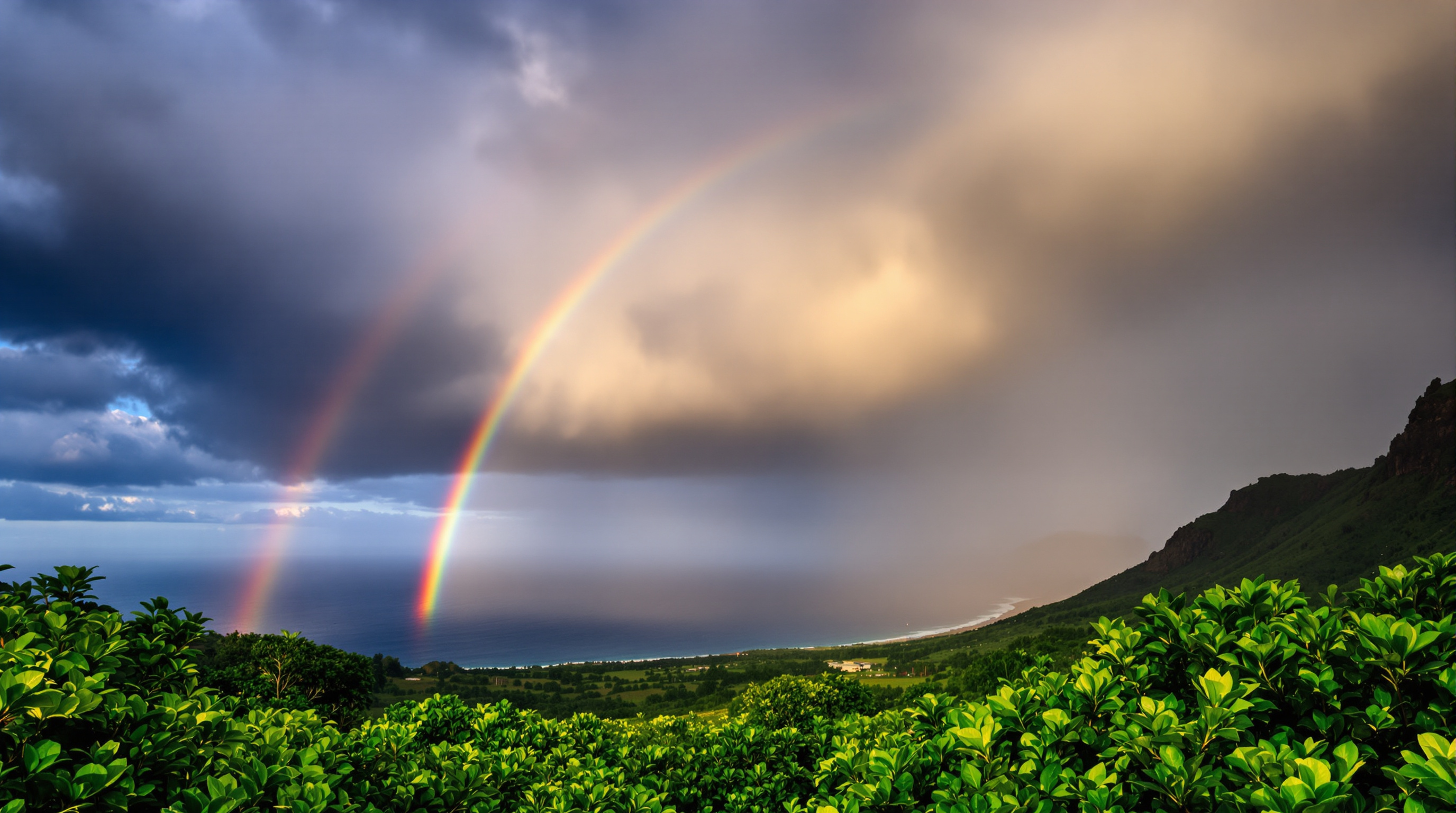
Here is a statistic worth more than any forecast app: in fifteen years of shooting family portraits and weddings on Kauai, the studio behind this site postponed exactly two sessions for weather. Two. On an island whose interior is among the wettest places on earth. If that sounds impossible, you do not yet understand Kauai rain - and understanding it will save your photographs.
An Island of Microclimates
Mount Waialeale, in the island's center, wrings staggering amounts of rain out of the trade winds - the summit averages around 400 inches a year, among the highest totals recorded anywhere, per the U.S. Geological Survey. But that same mountain creates a rain shadow, and the coasts live in it. Poipu on the south shore may see a tenth of the summit's rainfall. The practical meaning for a photographer is simple: rain where you are standing says almost nothing about rain where you are shooting. It happened to the studio constantly - an hour's drive to a session through pouring rain, only for the squall to lift a mile from the beach and the site itself to be in sunshine.
The Upwind Trick
The most useful weather instrument on Kauai is a parking lot that faces upwind. Before canceling anything, drive to a viewpoint where you can see the weather approaching - on the north shore, the east end of Princeville works perfectly - and watch the sky upstream of your location. Kauai squalls are cellular: they arrive in distinct packets with gaps between them, and you can often see your next forty-five minutes of weather laid out over the ocean.
The studio's defining example: a portrait session scheduled below the bluffs at Princeville on an evening when the sky had been sealed gray all day. Waiting at that upwind lot, phone in hand, mid-sentence into the call that would have canceled the shoot - a tiny strip of blue opened on the horizon. Wait a few minutes, the client agreed. The strip widened. By the time the photographer drove the two miles to the beach, the entire sky had opened into one of the best sunsets of the season, and the session went ahead in glowing light. The lesson stuck for fifteen years: never cancel before the last possible moment, because on Kauai the weather forty minutes from now is frequently nothing like the weather overhead.
Working Rules for Wet Forecasts
- Ignore the daily icon. A 70 percent rain forecast for "Kauai" usually means brief passing showers somewhere on the island - not six wet hours at your beach. Read the hourly graphs and radar loop from the National Weather Service Honolulu office instead.
- Hold a flex window. Schedule sessions with a half-hour buffer on each side. Most squalls pass through in fifteen minutes and leave washed, saturated light behind - some of the best portrait light the island makes.
- Have a dry-side fallback. If the north shore is socked in, the south shore probably is not. The drive is under an hour and a half; a session moved beats a session canceled.
- Embrace the rain itself. Showers make rainbows, and Kauai produces more of them than anywhere we know. Keep shooting through the edge of a squall with the camera under a jacket and you may take home the best frame of the trip.
Keeping Gear Alive in Island Weather
Shooting through Kauai showers is only worth it if the camera survives the habit. The real enemy is not the rain but what follows it: warm salt-laden air condensing on cold glass, and fine grit carried in on wet hands. A plain plastic sleeve or even a shower cap over the body handles a passing squall better than most purpose-built covers, and a microfibre cloth kept dry inside a zip bag is worth more than three kept damp in a pocket. Change lenses inside the car, never on the sand in wind. When the session ends, wipe the body down before it goes in the bag, leave the bag open indoors overnight, and rinse tripod legs in fresh water - salt seizes leg locks faster than anything the island does to electronics.
When Rain Becomes a Storm
Treat the upwind trick as advice for passing squalls, not tropical cyclones. In its 7 October 2026 rainfall summary, the National Weather Service reported that Lowell brought 12 to 22 inches of rain to Kauai on 7 and 8 September. Rising rivers closed sections of Kūhiō Highway near Hanalei and Wainiha; later in the month, runoff associated with Nolo closed the highway at the Hanalei River Bridge.
The Mt. Waiʻaleʻale gauge recorded 68.68 inches that September, 227 percent of average and its wettest September in a record beginning in 2003. Its 30 September total was 15.79 inches; its year-to-date total was 404.53 inches. These are gauge measurements, not figures for every beach. The figures describe September 2026 and should not be read as present-day access reports. Clear sky does not establish open access. Follow official restrictions first; the park reservations and permits guide gathers the access sources.
What This Means for Your Shoot
If you wake on photo day to rain drumming the roof, do not reach for the cancellation email. Check the radar, drive to where you can see upwind, and give the island a chance to do what it almost always does: clear exactly where you need it, exactly in time. Out of fifteen years of sessions, that patience failed only twice. Those are odds worth planning around - and the same patience pays off after sundown too, as we explain in dramatic lighting after sunset.